MRI pulse sequence development · CMRR, University of Minnesota

I build MRI sequences for scans the product sequences can't do.

I design, program and validate custom pulse sequences on Siemens scanners, from parallel-transmit multiband EPI to high-resolution diffusion. Then I run them on people, phantoms and ex vivo samples until they work.

3T7T10.5T
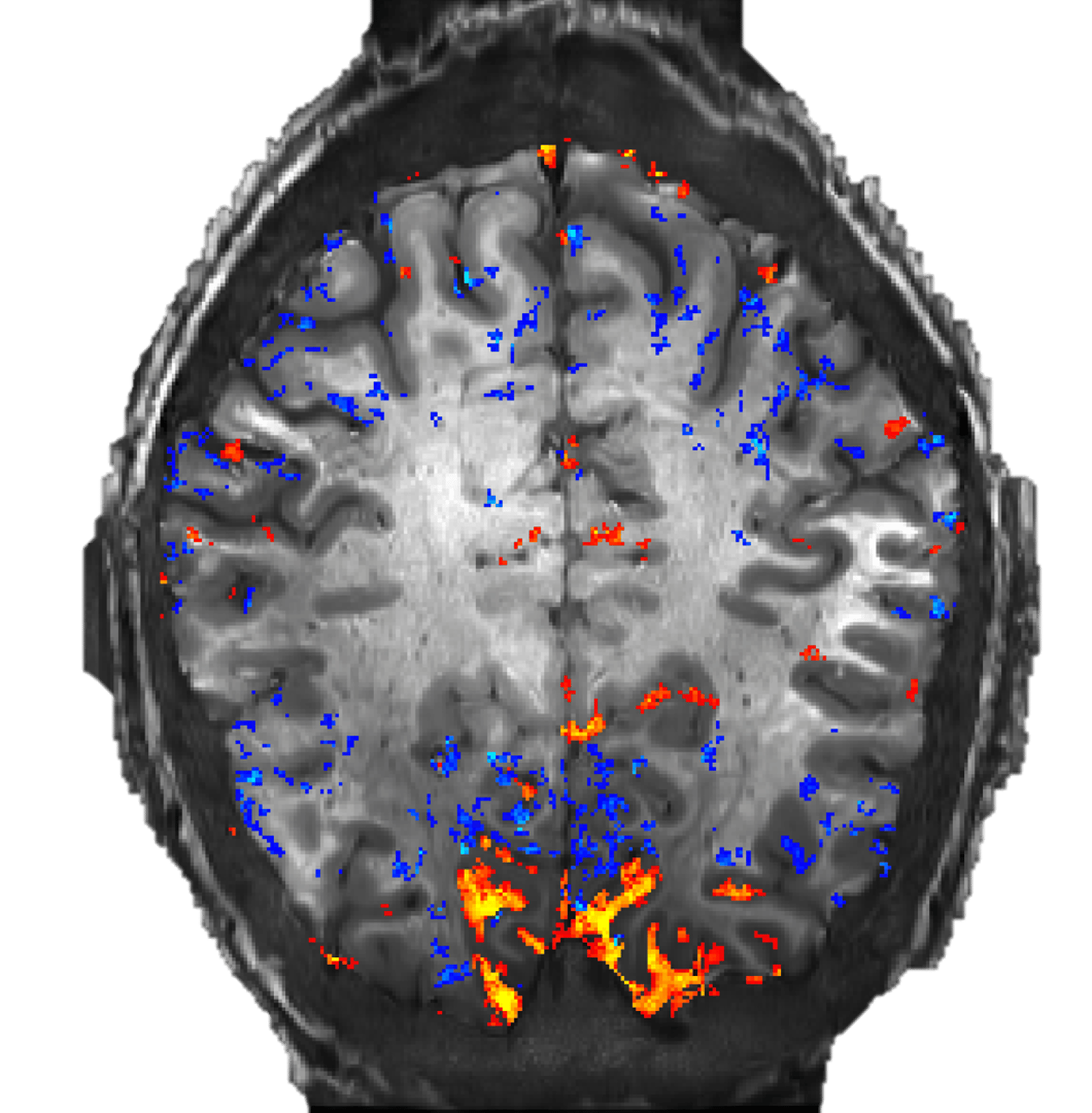
Visual cortex responding to a flickering checkerboard, recorded at 7T. The brain is mine.

What I do

From a new idea to a sequence that runs on the scanner.

I work at the Center for Magnetic Resonance Research (CMRR) as the technical lead on imaging projects for several research groups. I decide how each one gets implemented, write the code, test it, and keep it working until the data are collected.

01

Sequence development

Custom pulse sequences in Siemens IDEA on the VE and XA software lines: parallel transmit, multiband, SAR handling, and porting sequences between software versions.

02

Technical project lead

I check whether a project is feasible, define its scope, pick the implementation approach and deliver working sequences on grant timelines, for several PIs at once.

03

Ultra-high-field acquisition

I optimize protocols at 3T, 7T and 10.5T and am a scanner operator for collaborators' studies, with in vivo and multi-day ex vivo sessions.

04

Reconstruction, training and documentation

I deploy online reconstruction with OpenRecon, work with Siemens to troubleshoot, and write the documentation other people need to run new methods on their own.
Selected work

What I can bring to a project

pTx · Multiband · UHF

Parallel transmit for hard-to-image brain regions

At 7T and above, B1 inhomogeneity causes signal dropout in regions like the temporal lobes and cerebellum. I build parallel-transmit into sequences, so research groups can recover signal where standard transmit modes fall short.

Diffusion · 7T Terra.X

High-resolution diffusion at 7T

Sub-millimetre, HCP-style diffusion protocols on the 7T Terra.X. They are built for multi-subject studies, where every session has to produce usable data.

VE → XA · SAR

Moving sequences to new scanner software

When scanners move from the VE to the XA software line, custom sequences don't just recompile. I port them to the new IDEA architecture, including RF pulses and SAR handling, so ongoing studies can continue on upgraded systems.

EPI

EPI tailored to the study

When a product EPI doesn't quite fit a study, I adapt the sequence, so the acquisition fits the scientific question and not the other way round.

OpenRecon

Custom reconstruction on the scanner

I bring custom reconstruction code onto the scanner with Siemens OpenRecon. That means checking hardware and licensing, coordinating with Siemens, and debugging until the images come back at the console.

fMRI · 7T · 10.5T

Running functional imaging studies

I operate the scanner for collaborators' fMRI studies at 7T and 10.5T, from auditory paradigms to whole-brain resting state. I also measure how sequence settings and RF coils affect acoustic noise and image quality.

Publications

Latest papers and preprints

From magnetic particle imaging and cardiac MRI to layer-specific fMRI at 7T and 10.5T. Pulled from my ORCID record.

Full list with co-authors on ORCID →

Grants and fellowships

  • Co-Investigator, Cortical layer-specific imaging of context-dependent cognitive processing. MRC, £1.3M (2024)
  • Pilot data for Layer-specific cortical feedback dynamics. BBSRC, £700k
  • Pickford Travelling Fellowship, University of Glasgow
  • Flexible Talent Mobility Funding, BBSRC
  • Marie Curie ITN CardioNet PhD fellowship, with CNIC and Philips Healthcare Spain

Toolbox

What I work with

Programming

  • Siemens IDEA (VE12U, XA60)
  • C++ sequence programming
  • Python
  • Analysis scripting

Methods

  • Parallel transmit (pTx)
  • Multiband / SMS EPI
  • Diffusion MRI
  • High-resolution and laminar fMRI

Hardware

  • 3T, 7T Terra.X, 10.5T
  • 1Tx to 16Tx RF coils
  • OptoAcoustics noise measurement
  • Phantom and ex vivo setups

Background

About

I'm a medical engineer working in ultra-high-field MRI. I care most about the step between an idea on paper and data you can trust. I like work where the physics, the code and the person in the scanner all have to cooperate.

2025 – now

Center for Magnetic Resonance Research (CMRR), University of Minnesota. Pulse sequence development and technical project lead at 3T, 7T and 10.5T.

2018 - 2025

Imaging Centre of Excellence (ICE), Glasgow, UK. Sequences for sub-millimetre 7T fMRI to study how cortical layers interact during perception.

2012 - 2016

Centro Nacional de Investigaciones Cardiovasculares (CNIC), Madrid, Spain. Development of novel quantitative medical imaging techniques for MPI and MRI

Contact

Need a sequence the scanner doesn't have yet?

I'm glad to hear from researchers working on pTx, high-resolution fMRI or diffusion at ultra-high field.

Center for Magnetic Resonance Research (CMRR), University of Minnesota
2021 6th Street SE, Minneapolis, MN 55455, USA